
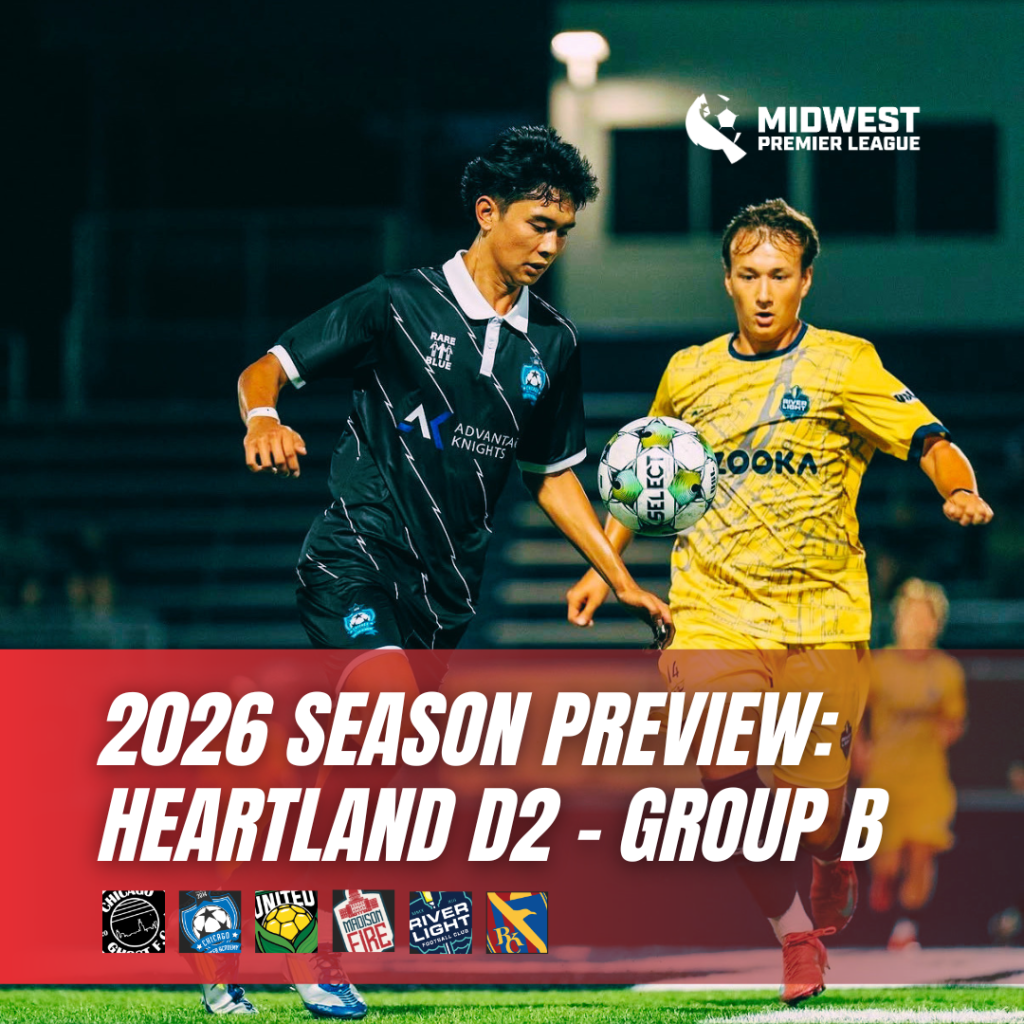
The Heartland Conference’s promotion-and-relegation structure has sharpened competition at every level, and Division 2’s Group B in 2026 is set to be its fiercest test yet. With only a single promotion spot on offer, six clubs will spend the season fighting tooth and nail for one golden ticket to Division 1, and the margin between success and another year in the second flight could come down to a solitary point.
Last season, Edgewater Castle FC claimed that prize with 20 points from 10 games, ascending to the top flight on the strength of a dominant campaign. Their departure leaves a vacancy at the top of Group B, and no shortage of candidates to fill it. Chicago Ghost FC finished fifth in the 2025 standings, just four points off the pace, and return to Division 2 with a retooled squad and sharper focus. RKC Third Coast brings the organizational DNA of a program that produced professional signings in Kajus Kontautas and Blake Gillingham. DeKalb County United drop down from Division 1 after a difficult 2025 campaign, arriving with top-flight experience that could prove decisive. River Light FC, Madison Fire and Chicago Soccer Academy make their Group B entrances, the former two sporting second teams, expanding the geographic footprint of the division from the Wisconsin state line to the Fox River corridor.

Chicago Ghost FC are perhaps the most intriguing storyline in Group B. After finishing fifth in Division 2 last season, Las Rosas have spent the offseason addressing the gaps that cost them. The departure of captain and top scorer Ben Goldberg is a significant blow, but the club has moved quickly to offset the loss, retaining leaders like Mateo Ormaza and welcoming an influx of collegiate athletes. Critically, the arrival of new head coach Phillip Kroft signals a shift in culture: a more structured, tactically mature approach to a division where consistency wins promotions. Chicago Ghost have been here before, nearly cracking the top spot. In 2026, they arrive knowing exactly what it takes, and what it costs to fall short.
RKC Third Coast‘s entry into Group B is one of the most significant developments heading into the season. The Racine-based organization has built a reputation for identifying and developing talent, a model that produced professional signings last year. They bring that same infrastructure to the MWPL. With roots in USL2 competition and a track record of preparing players for higher levels, RKC will not need time to settle in. The question is whether their development-first philosophy translates into results quickly enough in a compressed, high-stakes ten-game season.
DeKalb County United‘s relegation from Division 1 after the 2025 season, finishing sixth with 15 points, tells only part of their story. The gap between Division 1’s top clubs and its bottom half is not trivial, but United’s season in the top flight will have sharpened them in ways that matter. They know how to compete at a higher tempo. They carry the motivation of a club that has tasted the top division and wants to return, especially with Aiden Sears returning, in addition to welcoming 6’4 keeper Beckham Denu and attacking threat Britton Sala. In a group without a clear front-runner, that experience could be the differentiator.
River Light FC arrive from Aurora as one of three clubs new to the group, bringing with them the energy and hunger that characterizes first-season MWPL sides. Located in the Fox River Valley, River Light represent an exciting development for the league’s geographic growth. New clubs often take time to find their footing, but these guys have experience in USL2, and they’ll catch opponents who underestimate them. Their ceiling in 2026 is genuinely unknown, which makes them one of the division’s most compelling wildcards.
Madison Fire brings another new voice to Group B, crossing the state line from Wisconsin’s capital city. Madison has long been a strong collegiate soccer market, and the Fire will no doubt look to tap that pipeline as they establish themselves in MWPL competition. Like River Light, they are unproven at this level, yet experienced in USL2, so that also means they arrive without the weight of expectation. If they can organize quickly and lean on the passion of their fan base, the Fire could ignite more than a few surprises over the course of the season.
Chicago Soccer Academy rounds out the six-club group, bringing a youth development mission to the senior competition stage. Clubs rooted in academy structures can take time to build winning cultures at the adult level, but their access to a deep pipeline of home-grown talent is an asset that compounds over time. That time should be shortened with stars like George Maridis and others joining soon before the season begins. In a short season, the question for CSA will be whether their development philosophy can translate quickly into the grind of competitive match play.
Group B in 2026 does not have an obvious favorite, and that is precisely what makes it so compelling. Chicago Ghost FC arrive as the group’s most battle-tested side with the clearest promotion mandate and a new coaching voice to sharpen their edge. DeKalb County United carry top-flight experience that could make them immediately dangerous in a lower-tempo environment. RKC Third Coast bring organizational depth that expansion teams rarely possess. And River Light FC, Madison Fire, and Chicago Soccer Academy each carry the dangerous unpredictability of clubs with nothing to lose and everything to gain.
The Midwest Premier League’s broader 2030 Plan, built around sustainable club development and deeper community roots, is visible in every team that takes the pitch this season. The competition structure is working. The stakes are real. And with only one club earning the right to call themselves Division 1 when the final whistle blows, every match in Group B will carry the full weight of what this league has become.
Feature Interview: Matthew A. Alcala (Chicago Ghost FC)
As part of this season preview, we spoke with Chicago Ghost FC CEO Matthew A. Alcala about last season’s near-miss, the club’s approach to building a promotion-worthy squad, and what the 2026 campaign means for Las Rosas.
Fourth place was never the target, and fifth stung even more. But Alcala is clear-eyed about what it revealed. “Every point counts,” he said. “While our 2025 campaign was strong, we ultimately finished fifth, just four points shy of the top spot.” In a ten-game season, four points is the difference between a promotion parade and another year in Division 2. That lesson has shaped everything about how Chicago Ghost has approached 2026.
Chicago Ghost haven’t flinched at the arrival of new clubs or the structural changes to Group B. “We embrace adversity,” Alcala said, “and regardless of change, we will compete against all competition.” It’s the kind of quiet confidence that tends to come from a club that has already proven it belongs.
For Alcala, the balance of promotion and building foundation lies in the type of players Chicago Ghost recruit. “We prioritize recruiting collegiate athletes, as they understand the significance of every match and the preparation required to win key games.” Those players arrive already conditioned to high-stakes competition, weekly preparation routines, and the mental demands of a short season. The addition of new head coach Phillip Kroft is central to that approach. Alcala expects Kroft to “bring maturity and a winning mentality to both training sessions and matches, helping our players stay focused on each contest as it comes.“
The loss of Ben Goldberg, 2025 captain and the club’s leading scorer and assister, is real. Alcala doesn’t minimize it. But he’s equally energized by what’s coming. “We are excited to return a wealth of leadership from Mateo Ormaza,” he said, “and welcome an influx of talented collegiate players.” Ormaza steps into a larger leadership role at a moment when the club needs experienced voices to carry the standard that Goldberg set.
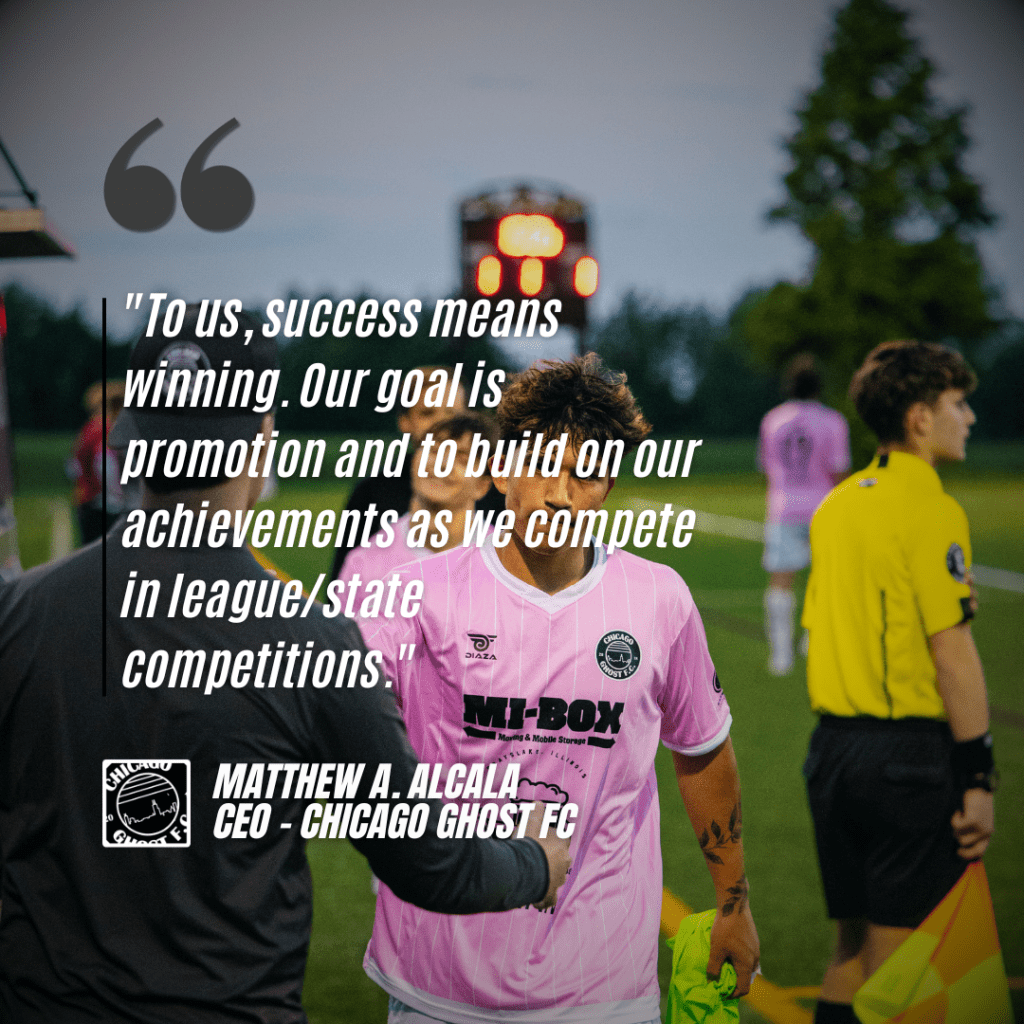
The answer to success is unambiguous. “To us, success means winning. Our goal is promotion and to build on our achievements as we compete in league and state competitions.” There is no hedging, no secondary objective. Chicago Ghost have tasted the near-miss. They know where the line is. In 2026, they intend to cross it.